New Era in City Planning Pt. 5
The draft OCP and the results of the OCP engagement were posted late Feb. 21 on the City’s website and brought forward for discussion and decision at the Feb. 27 Committee of the Whole meeting. Check the City site at victoria.ca under COUNCIL MEETINGS for details. The new OCP will have a major impact on all aspects of urban life throughout the city.
My purpose in writing these pieces has been to bring to the attention of Beacon readers some of the possibilities being considered for our future. The headline reads: One City One Plan.
In this month’s article, I’d like to share some of the ideas James Bay residents have expressed in letters to the editors, protesting on the streets, in conversation, and in written statements received (for which I am immensely grateful) in response to the question: “What principles would you like to see in the upcoming official community plan?”
Let’s begin with a blast from the past. The James Bay Neighbourhood Association website at jbna.org/about/our-history not only states a clear vision ahead but reveals a glimpse of how we got here:
In response to development proposals that were felt to be in contravention of the James Bay Neighbourhood Plan, the JBNA, through the James Bay Action Committee, held a series of forums that involved two hundred residents over several months in 2004–2005. The committees that formed have become cornerstones for ongoing JBNA activities. The vision statement these residents developed for James Bay is:
A dynamic, human-scale and diverse neighbourhood focused on a vibrant village core, that preserves its heritage, integrates its waterfront, and provides green spaces and accessible public transit.”
Here are some current voices which echo and amplify that vision.
Let’s start from the ground up. The OCP must acknowledge that the City exists within one of Canada’s rarest and most endangered ecosystems and commit to ecosystem preservation and enhancement. This commitment should be integrated into all other appropriate areas of the plan. The OCP must call for the City to develop (within timelines) a science-based biodiversity plan, similar to what’s currently underway in Saanich.
Our mature trees are irreplaceable. Build around or elsewhere. The same is true for existing parks, greenspace, and natural wild areas such as those on Holland Point and the undeveloped foreshore. Linear “greenway” corridors should be seen as an enhancement, not a replacement. Our “natural beauty” is a primary asset not only to our lives but to our tourism economy. To achieve “greening aspirations”, the OCP should include direction to establish environmental stewardship programs and expansion of food security and biodiversity initiatives.
The One City One Plan approach needs to be revised to acknowledge, respect, and build on the unique character, assets, and needs of each of our neighbourhood communities. To govern re-development and density distribution, the OCP should identify existing built-up areas and limit increases in them. Let’s see a moratorium on more “market housing” in densified areas until the rest of the city catches up. While far from perfect (we really could use that bakery) the human, economic and architectural diversity of James Bay could be a model.
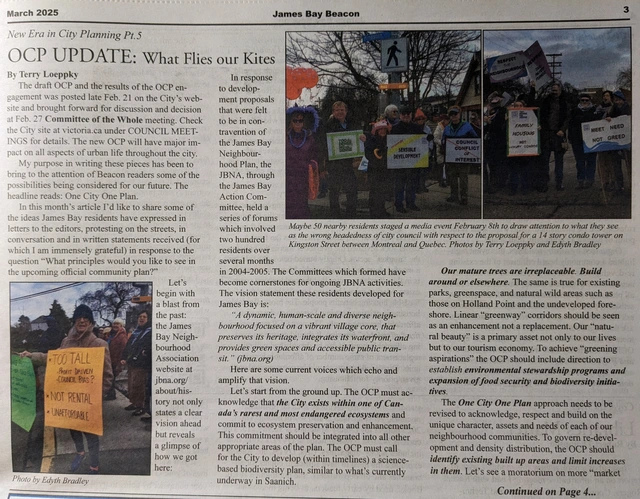
*Too Dense No Sense was the theme of the February 8 protest over the proposal to build a 14 storey condo between Quebec and Kingston at Montreal. This proposal is awaiting a public hearing regarding up-zoning changes. No one was objecting to replacing a parking lot with dwellings. Several signs supported “affordable family housing” on the site. At issue was council considering changes to the existing zoning in the current community plan, especially on the eve of a new improved OCP. As a recent letter to the TC said, “Until the existing community plan is updated to reflect the community’s current vision, the established rules should be maintained. Otherwise, what is the point of having a community plan at all?”
Organized by nearby residents, this event highlighted a commonly heard criticism of the existing re-development process. It seems all variables are re-negotiable. Developers ask for variances to seemingly all planning requirements: number of units, height, setbacks, parking, amenities, design… and then often ask for further changes. To verify that statement just ask the neighbours of multiple proposals on Government St and the Amica site on Douglas. The updated OCP should clearly state what is allowed generally, and if special heritage/historic/locational considerations apply, what is expected regarding preservation/enhancement. Urban villages and residential areas heights should be restricted to four floors. Densities should not exceed provincial guidelines. Under the new OCP re-development must adhere to all guidelines or seek another site on which to build.
More density brings with it increased demand on our aged infrastructure. We daily experience the condition of our roads and sidewalks… just ask any of the three seniors who fell on sidewalk cracks and heaves outside New Horizons this month. And what we see or trip over says nothing about what’s underground. It is incumbent on the City to identify costs associated with increased density and call on developers and senior governments to more fully compensate the city for infrastructure costs associated with proposed projects.
Housing Targets/Affordability
Much of this recent round of planning has been driven by housing targets established by the Province. This past year the City of Victoria announced those targets had been surpassed. There was fan fare! A closer look revealed the overshoot was in the only in the “market” sector. Quietly buried below the fold was a woeful short fall in “affordable” housing starts. It is in the affordable sector that the real housing crisis exists. Market-priced housing benefits investors. Affordable housing benefits people. The most affordable housing is existing housing. Demolition decreases affordable housing supply. The new OCP must prioritize “affordable” housing. It should ensure no existing affordable housing can be demolished without replacement of same number of affordable housing units. Displaced tenants should be compensated and given priority for rehousing.
As the price of purchase has sky rocketed there has been a shift to build more rental accommodation. Undoubtedly this is sorely needed, but we all ask “who is it for?”. More supply/density does not equate to affordability. Despite the headlines about existing housing shortages and rental starts I’ve seen vacancy signs on nearby rental buildings where they have rarely appeared over a 50 year span. I attribute this to rising rents. To support my anecdotal observation I offer this headline from CBC Vancouver 02/20/25
More vacancies but higher average rent prices forecast for Metro Vancouver: CMHC
I’m certain this trend is not limited to the lower mainland. It is clear, to me at least, that under the current system producing “affordable” housing for the general population or targeted groups (income/ability) is an impossibility. Without major changes to the rules, and significant co-operation between all players at all levels it will remain a chimera. The city must find alternatives to relying on private developers to supply housing at prices local people can afford or non market units as amenities to for profit units.
Lastly, gazing at into an uncertain future, the OCP update should provide for the needs and wants of those of us who reside here currently as well as those who will come when we build it.